About the project
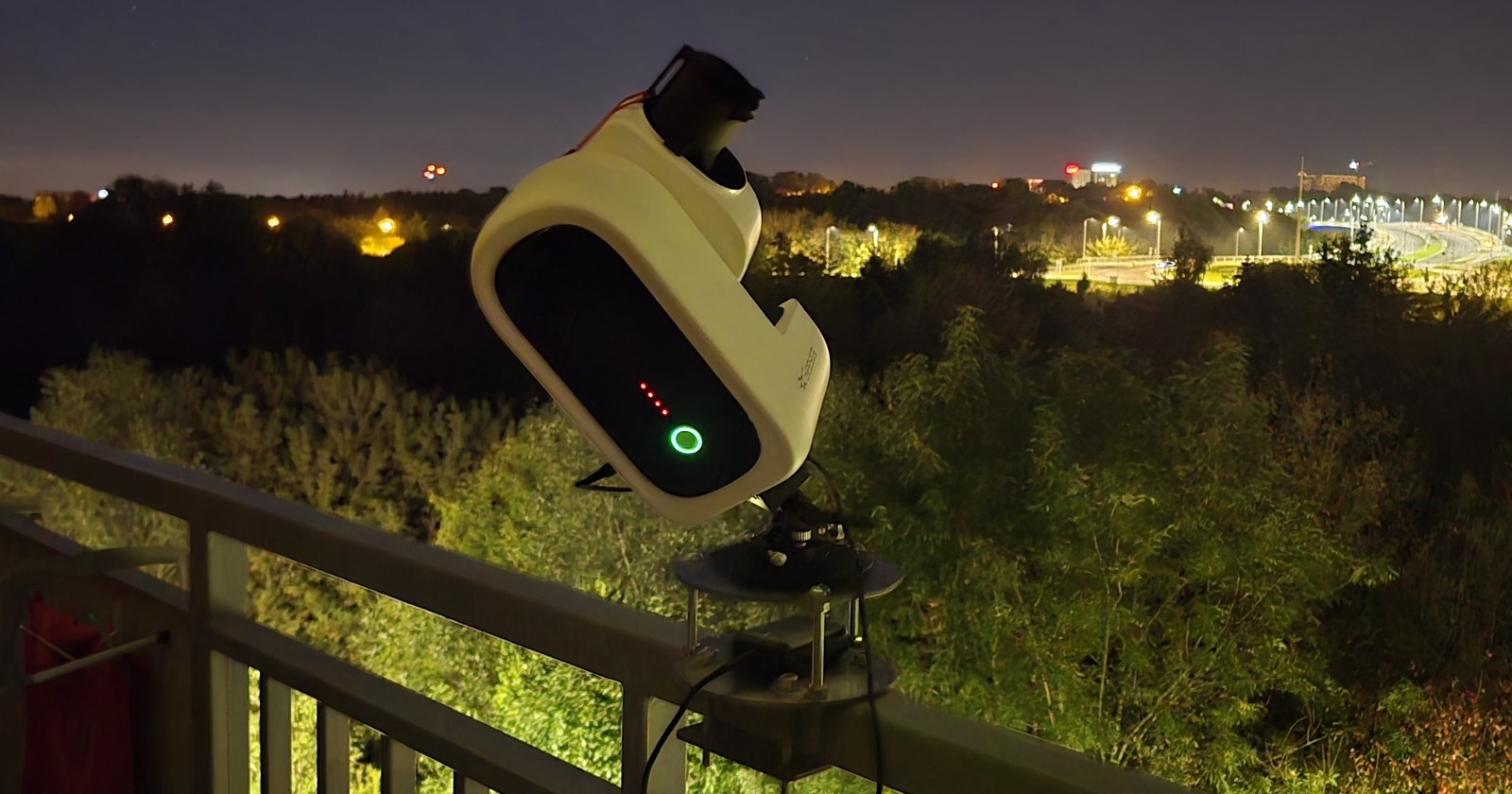
Seestar S50 Pro live from a balcony in Rzeszów
Astronocnik's live telescope streams astrophotography straight from my balcony. A Seestar S50 Pro smart telescope photographs nebulae, galaxies and star clusters, and you watch the image grow frame by frame - from a city, under light pollution, with no dark sky and no trip out of town.
What you'll see
Live image
The current stack from the telescope, refreshed every few minutes. Use the slider to go back to the first frames and watch the object emerge from the noise.
Tonight's plan
Targets with times, an altitude chart and the distance from the Moon. You can see at a glance what will be photographed and when.
Sky map
The real Seestar field of view on a map oriented the way the sky looks from my balcony, with the horizon. When the telescope is resting, you can explore it yourself.
Gallery
Images from previous nights in full resolution, with exposure time and filter. You can tweak each one with brightness, contrast and colour sliders.
Background music
Calm ambient music generated live in your browser, with no audio files. It reacts to the image: warm colours lower its pitch, a bright image makes the notes denser and contrast brightens the tone. Switch it on with the note icon above the image.
Hikari - night stories
While the live feed is switched on - also shortly before a session starts - an icon of a star with sound waves appears above the image. Tap it and Hikari tells a short story of a few minutes. The story is prepared with AI assistance and read by an AI voice that we created specially for Hikari. Nothing plays by itself.
How it works
Behind the live view a few parts work together all night long - without me touching anything.
The telescope shoots
The Seestar S50 Pro takes a series of short exposures (usually 10-60 s) and keeps stacking them into a single image.
A small computer collects frames
A computer on the balcony fetches the current stack every few minutes, stretches it and removes the city glow (DBE).
The image goes online
The finished image, tonight's plan and the telescope status are sent to the server. The page refreshes by itself, so you see what the telescope collected moments ago.
A gallery in the morning
When a target is done, the image moves to the gallery together with a replay of how the stack grew.
Equipment and location
| Telescope | Seestar S50 Pro (ZWO) - a smart telescope with a built-in camera and mount |
|---|---|
| Lens | 50 mm aperture, 260 mm focal length (about f/5.2) |
| Camera | 3840 × 2160 pixels, 2.9 µm pixels |
| Field of view | about 2.4° × 1.35° - several full Moons fit inside |
| Image scale | about 2.25 arcseconds per pixel |
| Mount | equatorial (EQ) mode on a fixed bracket on the balcony railing |
| Filters | built-in light pollution (LP) filter; I also test narrowband filters |
| Location | a balcony in Rzeszów, Poland - city sky, about Bortle 7 |
A balcony has its limits: buildings block part of the sky and city glow brightens the background. That's why I plan each night around targets that are high above the horizon on my side of the block.
What I photograph
The Seestar works best with bright deep-sky objects that fit its field of view. These are the usual suspects in my plans:
Questions and answers
Getting started
What is Astronocnik's live telescope?
It's a free live view from my Seestar S50 Pro telescope on a balcony in Rzeszów, Poland. During a session you see the current image of the sky getting more detailed with every frame, tonight's plan, a sky map with the telescope's field of view and a gallery of earlier images.
When does the telescope stream live?
When the sky is clear and dark - usually from astronomical dusk to dawn. The next session is announced on the main page in place of the image. In daytime, under clouds or in rain the telescope rests and you can browse the gallery.
Why is there no live image right now?
Most likely it's daytime, the sky is cloudy or the telescope is getting ready for the next target (slewing, focusing, first frame). The first image of a new target usually appears after a few minutes.
Can I control the telescope?
No - it's my private telescope and I plan the sessions myself. You can, however, move the Seestar frame around the sky map and see what would fit in it. If you have a target in mind, leave a note in the guestbook.
Is the website free?
Yes, the live view is free and ad-free. If you'd like to support it, you can buy me a coffee - it helps me buy new accessories and build new features.
Can I use the images from the gallery?
The images are mine. For private use - enjoy them and share the link to the site. If you'd like to use an image in a publication, presentation or online, contact me through the form on astronocnik.pl.
Seestar and smart telescopes
What is the Seestar S50 Pro?
It's a smart telescope by ZWO: a 50 mm lens, camera, mount, focuser, filter and computer in one body. You control it from a phone app - it finds targets on its own, focuses and stacks images live.
Is the Seestar good for beginners?
Yes, it's one of the easiest ways to start astrophotography. No polar alignment, no star hopping and no processing software - the first results show up within minutes. The limits are the small aperture and short focal length, so small galaxies and planets come out small.
What can you photograph with a Seestar?
Bright nebulae, large galaxies and star clusters work best. The Seestar also takes images and videos of the Moon and the Sun (with a proper solar filter). Planets are visible, but only as small discs - a longer focal length telescope is better for them.
How long do you need to expose for a nice image?
The outline of a bright target appears within minutes. A good image of a nebula from a city usually takes 1-3 hours of total exposure, and faint targets need several nights. You can watch this live - the slider shows how the image improved with every frame.
What is equatorial (EQ) mode on the Seestar?
By default the Seestar works in alt-azimuth mode and the sky slowly rotates in the frame, which limits the length of a single exposure. In equatorial mode the telescope is tilted along Earth's axis, so the field doesn't rotate and you can expose longer - up to 60 seconds per frame in my setup.
Which filter should I use with a Seestar in a city?
The built-in light pollution (LP) filter works great for emission nebulae. Narrowband filters cut the city glow even more, but need longer exposures. Galaxies and clusters are better shot without a narrowband filter, because they shine across a wide range of colours.
Do I need to focus the Seestar manually?
No, the Seestar has autofocus. With big temperature changes during the night it's worth refocusing, because the optics shift slightly as they cool.
Does dew affect astrophotography from a balcony?
Yes - on humid nights the lens can fog up within tens of minutes. A dew shield and a lens heater help. The Seestar has a built-in heater, and I also control it during the session.
Astrophotography from a city
Can you photograph stars and nebulae from a city?
You can - this website proves it. City glow brightens the background and lowers contrast, but a smart telescope, a light pollution filter and longer total exposure make up for a lot. Faint galaxies are the hardest, bright nebulae and clusters the easiest.
What is the Bortle scale?
A 9-step scale of night sky brightness: 1 is a perfectly dark sky far from cities, 9 is a big city centre. My balcony in Rzeszów is about 7, a suburban-to-urban sky - only brighter stars are visible and the Milky Way can't be seen with the naked eye.
Does the Moon get in the way?
Yes, especially around full Moon - it brightens the whole sky much like city glow. Tonight's plan shows each target's distance from the Moon. With a bright Moon I pick emission nebulae and a filter, and leave galaxies for darker nights.
Why are some objects only visible at certain times of the year?
Because Earth orbits the Sun and at night we face a different part of space. Summer and autumn belong to Cygnus, Lyra and Andromeda, winter to Orion and Taurus, spring to the galaxies in Virgo and Ursa Major. The chart in tonight's plan shows how high each target is at any hour.
Images on this website
Are the images processed?
Only automatically and lightly: these are raw stacks, stretched and with the background glow removed (DBE). The images are not edited by hand, retouched or enhanced with AI (AI is used only in Hikari's stories). This is the material a final image is made from.
Why are the first frames so noisy?
A single frame from a city collects little light from the target and a lot of noise. As frames add up, the noise averages out and the faint signal of the nebula adds up. That's why the image gets cleaner and more detailed every minute.
What is DBE and why do I use it?
DBE (Dynamic Background Extraction) removes the background gradient - the uneven glow from street lamps, city light and the Moon. The software models the sky background alone and subtracts it, so the target stands out and the corners aren't brighter than the centre.
What are the "Adjust" sliders for?
They let you tweak the image your own way: brightness, contrast, colour saturation and black point. Only you see the changes, so you can't break anything for anyone. The "Reset" button goes back to the original settings.
What do the emoji under the image mean?
They're viewers' reactions to the image from a given night. No login needed, and reactions from the live view move to the gallery together with the image. They show me which targets people like most.
Where does the music on the page come from?
It is generated live in your browser - there is no audio file. Several loops play single, soft notes from one scale, each at its own rhythm, so the pattern never repeats exactly (an idea known from Brian Eno's album "Music for Airports"). From the current image the page measures brightness, colour and contrast and gently changes the pitch, density and brightness of the notes. The music starts only after you click the note icon and you can always turn it off.
Hikari - night stories
Who is Hikari?
Hikari (Japanese for "light") is the narrator of this website - a character who reads short night stories during the live feed while I sleep. She is a fictional character, not a real person.
Is Hikari an AI?
Yes. The stories are prepared with AI assistance, based on my notes and facts from the project, and read by an AI voice that we created specially for Hikari. The player shows an "AI" badge - hover or tap it for the full information.
How do I listen to Hikari?
The story is available while the live feed is switched on - also shortly before a session starts, while the telescope waits for its first frame. An icon of a star with sound waves then appears above the image - tap it to start. Nothing plays by itself, you can scrub and skip 10 seconds back or forward, and the background music fades down while Hikari speaks. If you accept statistics, the page anonymously counts how far you listened (no IP address), so I know whether the stories are interesting. Plain clicks on Hikari and her archive are counted for everyone, but only as numbers: no IP address, no cookies and no identifier.
Can I listen to earlier stories?
Each new story is open to everyone only on its premiere night, during the live feed. At noon the next day it moves to Hikari's archive - the entrance is in the gallery, just below the "Straight from the telescope" note. The archive is my gift to people who have supported the project with a coffee. It is not for sale - I send the code personally, as a thank-you. Anyone can see the list of stories.
Glossary
- Stack (stacking)
- Combining many short exposures into one. Noise averages out and a faint target becomes clear.
- Frame
- A single exposure that goes into a stack - usually 10-60 seconds in my setup.
- Deep-sky
- Objects beyond the Solar System: nebulae, galaxies and star clusters.
- Emission nebula
- A cloud of gas that glows on its own, excited by hot stars. Usually red from hydrogen.
- Planetary nebula
- An expanding shell of gas thrown off by a dying Sun-like star, e.g. the Dumbbell Nebula.
- Messier catalogue (M)
- A list of 110 bright objects from the 18th century. Hence names like M31 or M42.
- NGC and IC
- Larger deep-sky catalogues. The Veil Nebula, for example, is NGC 6960 and NGC 6992.
- Field of view (frame)
- The patch of sky that fits in one image. The sky map shows it as a gold frame.
- Bortle
- A sky brightness scale from 1 (dark) to 9 (city centre).
- LP filter
- A light pollution filter that passes nebula light and blocks street lamps.
- DBE
- Background gradient removal - evens out city and Moon glow in the image.
- Plate solving
- Recognising stars in an image, so the telescope knows exactly where it's pointing.
About me

My name is Mariusz and I run Astronocnik - a Polish astrophotography podcast and a shop with accessories I design and make myself, including for the Seestar. I build things that work: an AllSky camera over Rzeszów, sky quality meters, dew heater controllers. The live telescope is another such project - I wanted anyone to be able to look over my shoulder while I photograph the sky.
See what the telescope is doing now
On a clear night you'll see the live image. If not - the gallery from previous nights and the plan for the next session.
Go to the live telescope